
mercredi 26 août 2026
Screw Foundations for Photovoltaic Installations: Optimal Solutions for Solar Farms
)
Structural Design Engineer
Ingenieur für Tragwerksplanung
Key Takeaways
Screw piles carry their design load the day they go in, which removes concrete curing from the build program.
No excavation means the soil structure stays intact, which simplifies permitting on agricultural land.
Torque monitoring on every pile turns load capacity from an assumption into a documented record.
Piles come out at the end of the lease, so decommissioning costs a fraction of concrete removal.
Why screw foundations for photovoltaic installations suit solar farm budgets
A poured footing needs excavation, formwork, and weeks of curing before racking crews can touch it. A screw pile reaches full design capacity the moment installation stops, so mounting structures follow the same day. On a multi-megawatt site, that takes foundation work off the critical path entirely.
Two line items leave the program with it:
Excavation and spoil removal, along with the haul roads and disposal costs attached to them
Concrete supply, formwork, and the curing period before any load can be applied
Light rigs also work on soft ground without access roads built for concrete trucks, at relatively low noise levels. Fewer deliveries and no spoil to remove keep site logistics lean.
Ground conditions and uplift loads decide the pile
PV tables are light structures with large surfaces, so wind uplift, not downward load, often governs the foundation design. A displacement screw pile resists tension through its thread and shaft friction, and it compacts the surrounding soil as it advances instead of loosening it. That behavior suits the sandy and peaty ground where solar farms usually end up, because the best land stays under crops.
Site condition | What it means for the foundation |
Sand and loose non-cohesive soil | Displacement action compacts the ground, usually the strongest case for screw piles |
Peat, wet ground, high water table | The pile passes through to a load-bearing layer, with no excavation and no dewatering |
Cohesive clay | Reliable capacity from shaft friction, confirmed by torque during installation |
Rock or buried obstacles | Pre-drilling, or a different foundation type on that part of the site |
Slopes and uneven ground | Depth and position vary pile by pile, so no terracing or cut and fill |
Installation rigs log torque, depth, and rotation speed for every pile, which is how capacity becomes auditable rather than assumed. Load tests on a sample confirm the design and prevent over-specifying steel across thousands of points, so screw pile foundations for photovoltaic installations can be tuned zone by zone across a variable site.
What happens when the lease ends
Most solar leases run 25 to 30 years and carry a land restoration clause. With concrete, that clause becomes a demolition contract: breaking, hauling, and waste disposal, all priced at the end of asset life. Screw piles unscrew and leave no material in the ground. Removal cost are at a minimum and the farming soil is preserved.
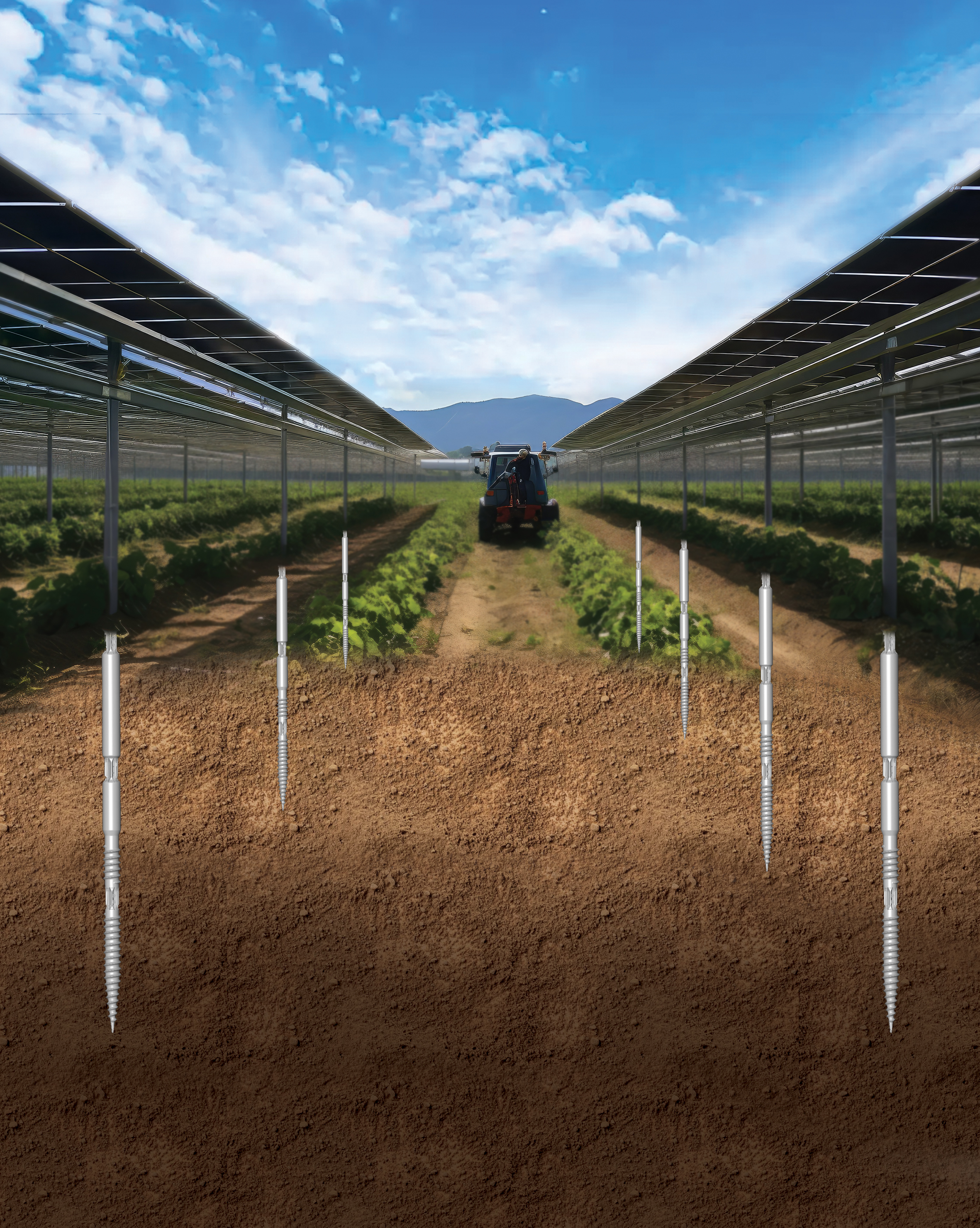
That same reversibility opens up dual-use land. Agri-PV foundations built to DIN SPEC 91434 keep the surface workable for crops or grazing while the array produces, which strengthens both the lease negotiation and the planning case.
Send your site layout and geotechnical report to the Winkelmann Foundation Screw engineering team and get a foundation design matched to your soil, wind zone, and mounting system. Contact Winkelmann Foundation Screw for a quote.
FAQ
How fast can foundations for a solar farm be installed?
Rates depend on soil, pile length, and site access. In favorable ground, a single rig places well over a hundred piles per shift. Foundations for a full row of tables go in within hours, and racking crews follow immediately behind. Ask your supplier to quote a rate against your geotechnical report rather than a catalog figure.
Do screw piles work on slopes and waterlogged ground?
Yes. Because nothing is excavated, installers vary the depth and position of each pile to follow a gradient or a high water table. Peat and sand, which defeat shallow concrete footings, are among the conditions where screw piles perform best.
How do I verify the foundations will last 30 years?
Ask for three things: certified production under EN 1090, hot-dip galvanizing for corrosion protection, and torque logs for every pile. Static load tests on a sample confirm the design against real ground data. Together, they give you a foundation package an auditor can check.