
Monday, June 29, 2026
Foundations for Load-Bearing Structures: Lighting Poles, Traction Poles, and Energy Infrastructure on Piles
)
Structural Design Engineer
Sales Director
Key Takeaways
Lighting columns, traction poles, and energy masts carry heavy vertical loads and high lateral wind loads, so the foundation must resist both pressure and overturning.
Screw piles from Winkelmann Foundation Screw (WFS) are driven straight into the ground and reach full load capacity the moment installation finishes, with no concrete and no curing time.
One modular system covers roadside lighting, traction poles, transmission masts, and low- to medium-voltage infrastructure, with pile heads, connection plates, and boosters sized to the load.
Installation needs no large excavations or road closures, and every pile can be removed and reused if the network is rebuilt later.
Why Poles and Masts Are a Demanding Load Case
A lighting column or energy mast is not a static weight resting on soil. It works as a lever, and the taller it stands, the harder the wind tries to tip it over. The foundation has to resist downward pressure and lateral overturning simultaneously, which is exactly where many shallow footings fall short. Soil conditions make this harder because the same pole on an embankment, between traffic lanes, or in soft fill needs a different answer each time.
How Screw Piles Carry Vertical and Lateral Forces
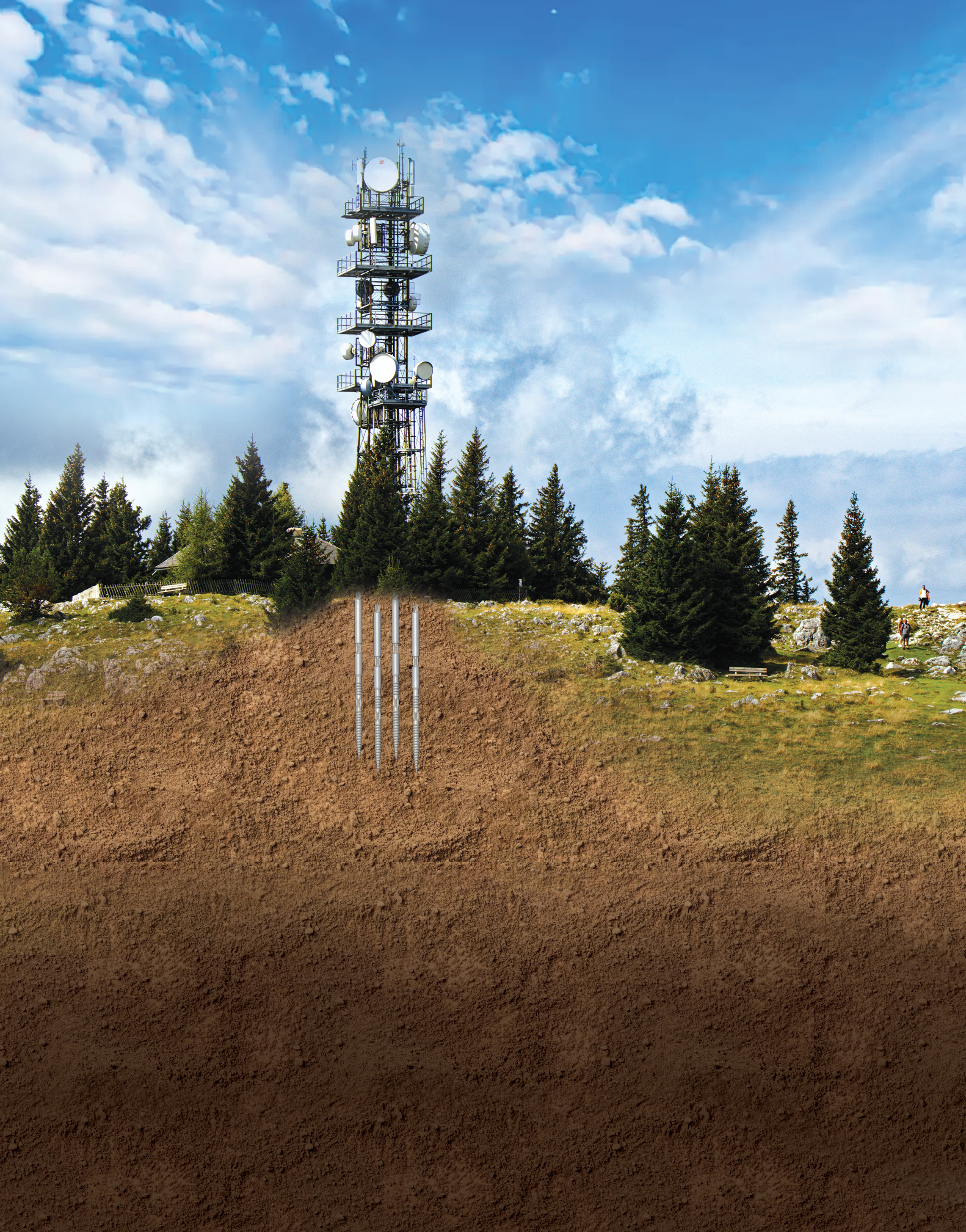
WFS uses displacement screw pile technology, which threads the shaft into the ground and compacts the soil around it as it goes. In cohesive soils, stability comes from shaft friction; in non-cohesive soils, end-bearing carries the load; and depth is adjusted to on-site conditions. A WFS pile reaches its rated capacity the moment it stops turning, so the superstructure can go up immediately rather than waiting on concrete to cure. That single property turns a multi-day footing into a same-visit installation.
One System for Lighting, Traction, and Energy Infrastructure
The same approach supports a wide spread of structures: roadside lighting columns, power cabinets, telecommunications masts, and transmission supports. For overhead rail electrification, WFS foundations for railway infrastructure anchor traction poles without disrupting the track environment, while foundations for urban infrastructure hold street masts, telecommunication poles, and EV charging points in tight city sites. WFS supplies a complete system, not just the pile, with connection plates, pile heads, and optional vertical and lateral boosters that raise capacity where the load demands it. You can see the full range on the page for foundations for lighting poles and energy infrastructure.
Installation Without Excavation or Road Closures
Because the pile is screwed in rather than dug in, the work stays contained to a single point. There are no large earthworks, no torn-up pavement, no road closures for roadside masts, and no clashes with drainage or buried services. Hot-dip galvanizing protects every pile against corrosion, including high-salinity roadsides, so the foundation lasts as long as the structure it carries. If the network is later rebuilt or moved, the piles are removed and returned to service, which is part of why the system offsets foundation-related CO2 compared to poured concrete.
Planning lighting, traction, or energy infrastructure and want foundations that install fast and carry load on day one? Talk to the Winkelmann Foundation Screw engineering team about your site conditions and get a design matched to your project. Contact WFS to get started.
FAQ
Can screw piles handle the wind loads on tall lighting masts?
Yes. Screw piles resist both vertical and lateral forces, and capacity is set during design using boosters and pile length matched to the mast height and local wind conditions. WFS provides the calculation data, so the foundation is sized for the specific structure.
How quickly can a pole foundation be installed?
A screw pile reaches full load capacity as soon as it is in the ground, so there is no curing delay. In practice, the foundation and the pole can often be installed in the same site visit, depending on ground conditions and the number of points.
Are screw pile foundations suitable for permanent energy infrastructure?
Yes. Hot-dip galvanizing gives long-term corrosion resistance for decades of service, and the piles meet European construction standards. They stay fully demountable, so a permanent installation can still be recovered and reused if the network changes.