
Wednesday, May 27, 2026
What Foundations Should You Choose for Containers?
)
Structural Design Engineer
Sales Director
Key Takeaways
Screw foundations allow for one-day installation without excavation or site damage.
Modern steel piles support heavy loads and provide a stable foundation for multi-story structures.
No concrete means a smaller carbon footprint and a much cleaner construction site.
Screw piles serve investments for decades, debunking the myth that they are only for temporary use.
The decision about the foundation is made long before the first modules are delivered to the construction site. Investors are increasingly faced with a choice between traditional prefabricated concrete units and a modern steel-pile system. This choice dictates the project schedule, the total budget, and the flexibility of the entire infrastructure.
We will look at both solutions and explain why the modular construction industry is moving away from heavy concrete toward innovative steel.
The Hidden Costs of Concrete Foundations
Concrete blocks and foundation footings are solutions that have been used in construction for many, many years. Construction crews lay them on a previously prepared subgrade or a special lean concrete footing. This solution carries hidden operational costs in the form of heavy machinery requirements and deep ground interference.
Prefabricated units are considered stable, but their installation process depends on weather conditions and significantly extends the entire project timeline. Removing such a foundation years later involves highly expensive rubble disposal and permanent damage to the plot. Additionally, transporting heavy blocks requires high-capacity access roads, posing a massive logistical hurdle in the early stages of many construction projects.
Screw Foundations as the New Standard in Construction
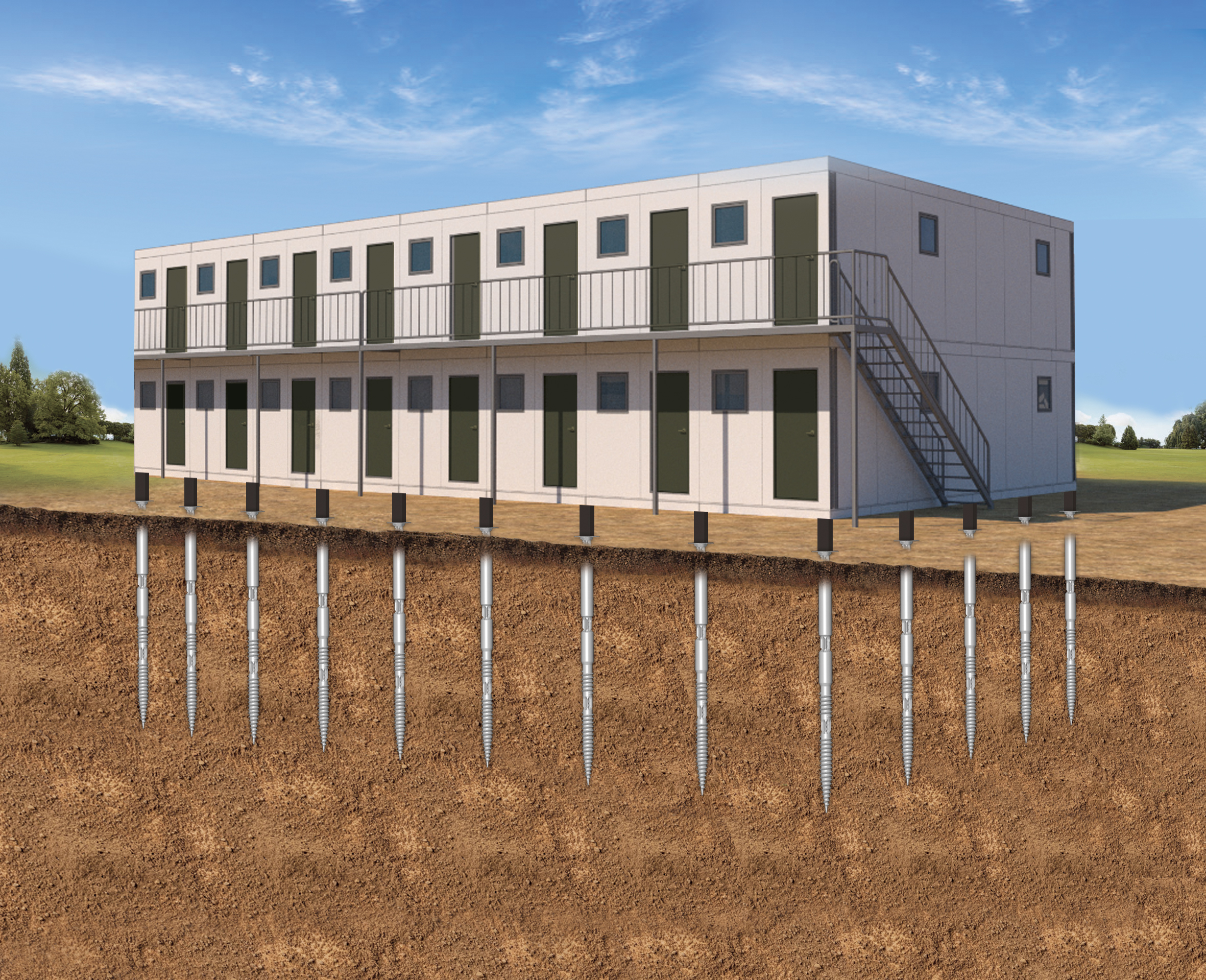
Screw foundations are technologically advanced steel piles screwed directly into the ground using dedicated machinery. The modular structure rests on steel heads, completely without contact with damp ground, which effectively protects the container floor from ground moisture. Installers typically complete the entire assembly in just a few hours, allowing for immediate placement of the objects without waiting for materials to cure.
For years, a myth has grown in the industry that screws are only for short-term construction site facilities. Current technology completely contradicts this outdated approach, offering load-bearing parameters that exceed traditional methods.
Load Capacity for Heavy Investments and Multi-Story Facilities
Advanced screw piles are designed to carry massive compressive and uplift loads easily. Thanks to the precise selection of wall thickness and spiral diameter, this system safely supports multi-story office containers and heavy energy storage systems. The appropriate anti-corrosion coating ensures that the steel foundation lasts in the ground for decades without the slightest technical issue. It thus represents a fully-fledged and often safer alternative to traditional foundation footings. Driving the piles also involves continuous torque measurement, giving engineers immediate confirmation of adequate soil bearing capacity even before the building is erected.
Ecology and Zero Carbon Footprint
The environmental aspect currently plays a very important role in modern commercial projects. Driving piles does not require hauling away soil or pouring hundreds of gallons of environmentally harmful concrete, thereby reducing the investment's carbon footprint. Using screw foundations protects the soil's natural water conditions and preserves an intact ecosystem on the construction site. When the investment comes to an end or changes location, the steel elements can simply be unscrewed and reused in a completely different project. Such a circular economy model is a huge advantage when applying for green building certificates and eco-friendly funding.
The Role of Geotechnical Testing
Regardless of the final foundation technology chosen, the foundation of success is always proper site investigation before work begins. A thorough geotechnical analysis allows engineers to precisely select the optimal length and placement of individual support points. Even minimal ground settlement under a heavy load can damage the plumbing inside the module. A good soil test avoids such costly surprises and guarantees the containers' stability for many years of use.
Send your facility's design to the specialists at Winkelmann Foundation Screw, and our engineers will prepare a detailed quote for an advanced screw system tailored to your requirements.
FAQ
Will screw piles support a multi-story office container?
Yes, modern screw systems handle very large tonnages perfectly. A properly designed pile layout easily transfers the loads of multi-story modular structures without any problem. The key to success is always selecting the right pipe cross-section and spiral size based on professional soil bearing tests conducted by an experienced geotechnical engineer.
How does the cost of a screw foundation compare to concrete?
The initial cost of the steel material itself is often similar to that of concrete prefabricated units, but that is only a small part of the overall construction economics. Steel piles reduce labor and logistics costs because they do not require renting heavy excavators or incurring the expense of soil removal. A total investment budget based on an innovative screw-in system is ultimately much more favorable for any investor.
What about very difficult soil conditions?
Steel piles perform excellently in wetlands, steep slopes, and highly unstable fill soils. Installation machines screw them precisely down to the deep load-bearing layers, which is impossible to achieve with shallow concrete precast units without prohibitively expensive soil replacement. This is exactly what makes them a versatile and reliable foundation in construction market.